Washington / State capitals — A recent surge in political attention to foreign ownership of U.S. agricultural land has sparked a contentious debate about national security, transparency and farmland policy. Federal officials and some lawmakers say that foreign holdings — chiefly parcels purchased by investors over the past decade — could create vulnerabilities if owners have ties to foreign governments. Others warn the threat is being overstated and that sweeping restrictions risk chilling investment and violating property rights.
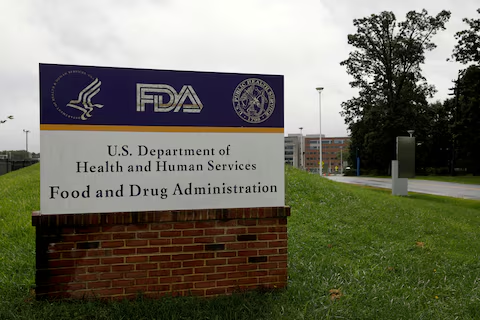
The discussion intensified after administration officials highlighted examples of foreign-owned acreage near sensitive sites. That prompted the U.S. Department of Agriculture to roll out a plan aimed at limiting purchases by investors tied to so-called adversary countries, while Congress has advanced bills to tighten reviews of agricultural land transactions.
What the data show
Foreign investors held roughly 45 million acres of U.S. agricultural land as of the end of 2023, equivalent to about 3.6% of all privately held farmland, according to the Department of Agriculture’s most recent AFIDA data. Holdings rose modestly year-on-year, driven in part by purchases tied to renewable-energy projects, timber, and investment portfolios. Canadian and European investors account for the largest shares; Chinese-linked ownership comprises a small portion of total foreign acreage — under 1% in some estimates — though that fraction has drawn outsized attention.
A Government Accountability Office review and other analyses have flagged the lack of real-time, detailed disclosure about who ultimately controls some foreign investments in land. That reporting gap fuels uncertainty and has helped spur legislative proposals to tighten notification and review requirements.
National-security concerns voiced by officials
Officials who speak of security risk typically highlight two broad worries, framed at a high level rather than as tactical prescriptions:
- Proximity to sensitive facilities. Critics argue that ownership or control of land adjacent to military bases, testing ranges or critical infrastructure could, in some scenarios, raise surveillance or access concerns. They say access to land near these sites could make certain kinds of intelligence-gathering or interference easier to attempt, or create staging areas for illicit activity — though experts stress that the presence of private farmland alone does not equal an operational threat.
- Critical-infrastructure and supply vulnerabilities. Some policymakers fear that foreign holdings in key agricultural regions could give foreign interests leverage over food supply chains, distribution networks, or agribusiness infrastructure during crises. Those worries link to broader debates about food security and strategic resilience.
Officials and legislators emphasize these points when arguing for more rigorous screening, blocking certain buyers, or even clawbacks of land bought by entities tied to adversary states. In July 2025 the administration announced new measures intended to impede purchases by flagged foreign entities and bolster interagency reviews.
What experts and independent reporting say
Independent analysts urge caution in leaping from concern to sweeping policy. Several lines of reporting and commentary note:
- Low absolute scale of Chinese ownership. While politically salient, Chinese-linked holdings represent a small slice of total foreign acreage. Overblown maps or headlines can give a misleading impression of widespread ownership near every military facility. Localized examples exist, but nationwide exposure appears limited relative to the total land base.
- Motives vary and many owners are passive investors. Many foreign purchases are investment or agricultural businesses with no apparent intent to influence policy or threaten security; other purchases fund renewable-energy projects or timber. The “who” behind a purchase matters — opacity raises questions, while transparent, commercial actors pose fewer concerns.
- Evidence of coordinated, state-directed exploitation is thin. Public reporting so far shows limited direct evidence that foreign farmland acquisitions have been used as part of an intelligence or military campaign; nonetheless, the potential pathways worry security officials and drive calls for preventive rules.
Policy responses underway
Policymakers have proposed and implemented several responses that aim to balance security with property rights and economic interests:
- Tighter screening and reporting. Legislation such as the Agricultural Risk Review Act and other proposals would expand review authority, require clearer reporting of who ultimately owns land, and route more transactions for interagency scrutiny. Supporters say the moves improve transparency and allow authorities to flag suspicious deals early.
- Targeted bans and exclusions. Some federal and state proposals go further, seeking to prohibit purchases by nationals of certain countries or by entities that fall under specific foreign-control definitions. Several states have already passed restrictions limiting sales within a buffer around military installations. Critics argue these laws can be blunt instruments and raise constitutional questions.
- Clawback and remedies. The administration has discussed mechanisms to unwind purchases made by entities that misled regulators — though implementing large-scale reversals raises legal, administrative and ethical complexities.
- FIU/CFIUS-style reviews for agriculture. Some policymakers want to expand tools akin to the Committee on Foreign Investment in the United States (CFIUS) — which reviews transactions for national-security implications — to focus systematically on agricultural land and related assets. Such proposals aim to apply national-security expertise to complex ownership structures.
Tradeoffs and legal questions
Stricter restrictions carry tradeoffs. For one, foreign capital currently helps finance certain rural projects, renewables and farm consolidation; abrupt bans could depress investment and raise costs for U.S. producers. There are also legal and diplomatic risks: measures targeted specifically at citizens of one country may provoke retaliation and run afoul of anti-discrimination norms unless carefully designed.
Further, enforcement hinges on good data. The U.S. has struggled with timely, granular information about who owns what land through proxy entities. Improving reporting standards may be a necessary first step before imposing heavy restrictions.
Practical mitigation strategies (policy side)
Experts and officials propose several measures aimed at reducing plausible risks while avoiding overreach:
- Improve transparency. Mandated disclosure of beneficial ownership for land transactions would let authorities and communities see who controls nearby parcels. Clearer data reduces false alarms and speeds lawful reviews.
- Targeted geographic buffers. Some states already restrict purchases within specified distances of sensitive installations; federal guidelines could standardize risk-based buffers for high-value national-security facilities, applied narrowly to avoid blanket bans.
- Strengthen interagency review. Creating streamlined processes that bring together defense, homeland security, agriculture and intelligence expertise can produce faster, better-informed decisions on risky transactions.
- Engage local communities. Local officials and community stakeholders should get a voice where land purchases may affect safety, environment or critical infrastructure access.
- Promote investment channels that include safeguards. Rather than banning all foreign investment, governments can craft partnership frameworks — for example, investment agreements that include vetting, oversight, and local-content commitments — to reap economic benefits while limiting security exposure.
Bottom line
The political salience of foreign farmland ownership — particularly holdings tied to Chinese entities — has pushed the issue from obscurity into mainstream policy debate. The core question for policymakers is how to reduce credible risks to national security without unnecessarily stifling investment, violating legal protections, or provoking diplomatic blowback.
Data show foreign holdings are substantial in aggregate but uneven by country and region. Officials rightly argue for vigilance where land sits close to sensitive facilities or where ownership is opaque. At the same time, independent analysts urge careful, evidence-based policy that improves transparency and targets genuine risk rather than reacting to headlines.
Ultimately, the debate underscores a broader tension in national security policy: protecting critical assets while preserving an open economy. The next year will likely see more legislation, tighter disclosure rules, and deeper interagency coordination as the U.S. seeks a practical middle path.