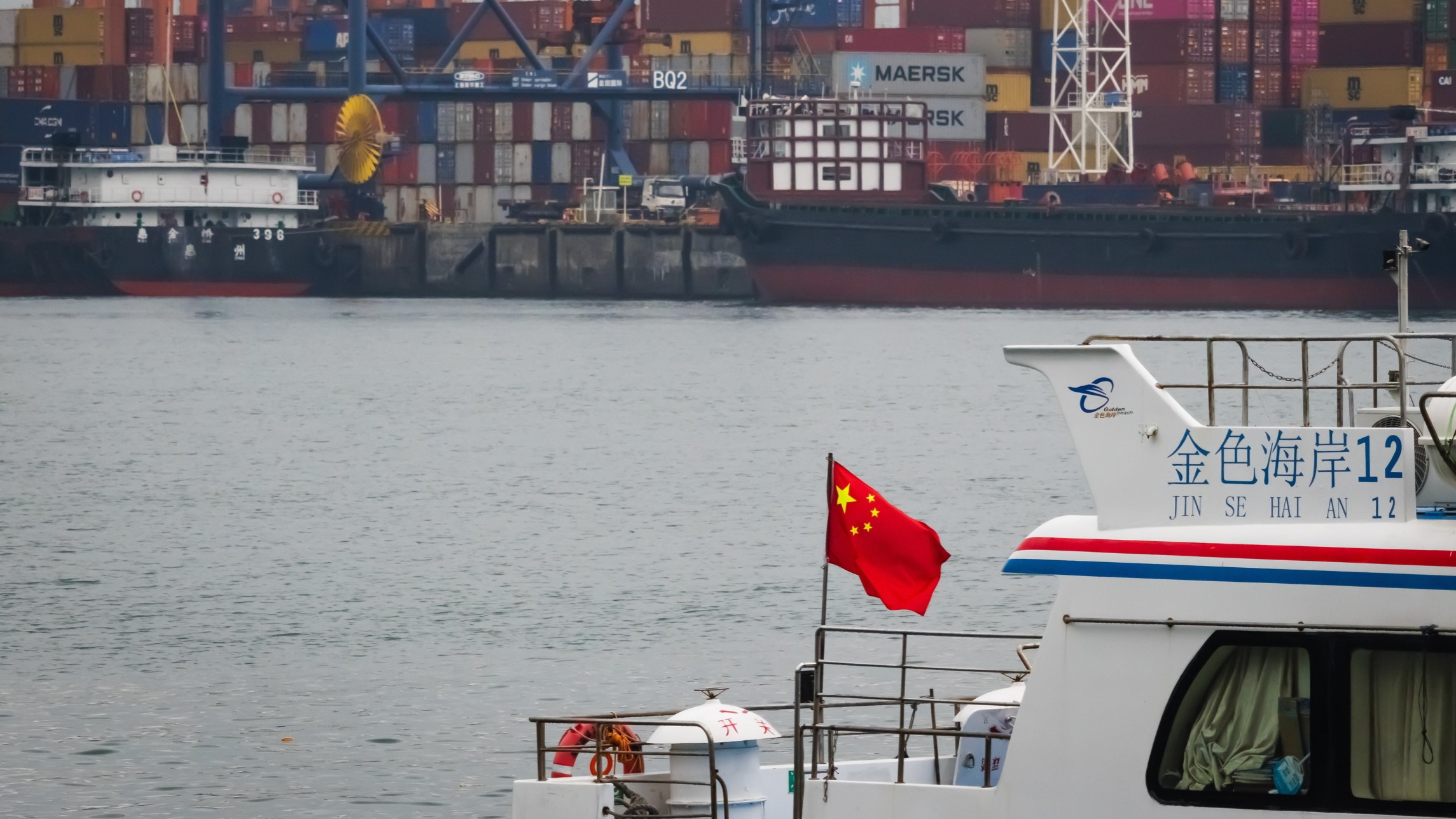
In a move signaling deepening maritime and trade tensions between the world’s two largest economies, China has announced new port fees targeting American vessels. The decision, unveiled by Beijing’s Ministry of Transport, comes as a direct countermeasure to the United States’ recently imposed port charges on Chinese-affiliated ships.
Beginning October 14, ships that are U.S.-owned, operated, flagged, or built will face a special port fee whenever they call at Chinese ports. The charges will start at 400 yuan (approximately $56) per net ton per voyage, gradually increasing to 1,120 yuan ($155) per ton by 2028. Each vessel will be required to pay this fee for up to five voyages annually.
Beijing described the move as a “legitimate countermeasure” against what it called “discriminatory practices” by Washington, asserting that the U.S. policy unfairly penalizes China’s shipbuilding sector and distorts the global maritime order.
Background: U.S. Policy Sparks a Maritime Clash
The U.S. government’s recent decision to impose port fees on vessels with Chinese ties — including those built in China, flagged under the Chinese registry, or majority-owned by Chinese firms — triggered immediate backlash from Beijing. Washington had justified its measure as part of broader efforts to ensure “national security and fair competition” in the shipping sector, citing concerns about Chinese control over global shipbuilding and logistics infrastructure.
For China, however, the move represents a direct economic and strategic challenge. Chinese state media and officials have framed the U.S. fees as part of a larger containment effort, accusing Washington of using maritime regulations to gain leverage in trade and technology disputes.
China’s Broader Definition of ‘U.S. Ships’
What makes China’s retaliatory measure particularly impactful is the broad scope of its definition of American-linked vessels.
According to the Chinese Ministry of Transport, ships will qualify for the new fee if:
- They are built in the United States,
- Operated or flagged under U.S. jurisdiction,
- Owned by American firms, or
- Have 25% or more of their shares or board seats held by U.S.-domiciled investment funds.
This expanded definition captures not only ships directly operated by U.S. companies but also those indirectly tied to American capital markets — including international shipping lines with partial U.S. ownership.
Industry analysts warn that this could pull a wide range of vessels into the new fee regime, including ships chartered by global logistics giants and multinational corporations that rely on U.S. financing.
Economic and Logistical Implications
The impact of China’s decision is expected to ripple through global supply chains, particularly those connected to the trans-Pacific trade routes that handle hundreds of billions of dollars in goods annually.
1. Rising Costs for Shipping Companies
Maritime operators may face a significant rise in operational costs, as port fees on both sides of the Pacific accumulate. Some firms may attempt to reflag ships under non-U.S. or non-Chinese jurisdictions or restructure ownership to circumvent the charges. However, these steps are costly, bureaucratic, and time-consuming.
2. Dual Taxation on Trade Routes
Some ships might be subject to double port fees — first under the U.S. policy targeting Chinese-built or flagged vessels, and again under China’s retaliatory charges. This could make trade between the two countries even more expensive, potentially discouraging smaller operators and driving up freight rates.
3. Complex Enforcement Challenges
For China, implementing the measure effectively will require a deep dive into the ownership and governance structures of thousands of ships — a daunting task given the opaque and multinational nature of modern maritime ownership. Vessels often operate under complex arrangements involving shell companies, subsidiaries, and cross-border financing.
4. Supply Chain Disruptions
With global trade still recovering from pandemic-related disruptions and energy price fluctuations, the new fees could introduce further instability. Analysts warn of potential delays in cargo movement, higher shipping insurance costs, and increased consumer prices if carriers pass costs downstream.
Political and Diplomatic Repercussions
The timing of China’s move is notable. It comes just weeks before planned trade consultations between U.S. President Donald Trump and Chinese President Xi Jinping. Observers suggest Beijing may be leveraging the port fees as a negotiating tool, signaling its readiness to escalate economic countermeasures if Washington continues to impose punitive trade restrictions.
China’s Messaging
Beijing’s official statement emphasized the principle of reciprocity. “If the United States chooses to take discriminatory actions that harm fair trade and global shipping stability, China will respond accordingly to protect its legitimate interests,” a spokesperson from the Ministry of Commerce said.
State-run media outlets framed the policy as a demonstration of China’s determination not to yield under U.S. pressure, portraying it as part of a broader struggle to preserve sovereignty and equality in international trade.
U.S. Reaction
In Washington, reactions were mixed. Shipping associations and trade groups expressed concern that the tit-for-tat measures could escalate into a maritime trade war, further complicating logistics for industries already strained by tariffs, supply bottlenecks, and geopolitical risks.
A spokesperson for the U.S. Department of Transportation said the administration was “reviewing the implications” of China’s announcement, while insisting that the U.S. port fee policy was “based on national interest and transparency.”
Industry Voices: Navigating a New Trade Reality
Shipping experts note that the back-and-forth tariff-style escalation mirrors previous disputes over semiconductors, solar panels, and technology exports.
“Maritime trade has become the latest frontier in U.S.-China competition,” said Dr. Li Hong, a trade policy analyst at Tsinghua University. “What used to be a purely commercial issue is now deeply political.”
Similarly, U.S.-based shipping consultant Mark Peterson warned that cost-sensitive sectors like manufacturing, agriculture, and consumer goods could feel the effects first. “When shipping costs rise, everything from electronics to food prices can increase,” he noted.
Looking Ahead
While the new fees may not immediately disrupt major trade routes, they represent another layer of friction in an already strained economic relationship.
Experts predict that unless both governments reach a compromise or rollback agreement, these reciprocal fees could become a long-term fixture of U.S.-China maritime relations — potentially reshaping how global shipping networks are structured.
Beijing’s policy, according to analysts, reflects both retaliation and strategic calculation. By imposing costs on U.S.-linked maritime operations, China signals its readiness to bear short-term economic pain to assert its sovereignty and deter further American restrictions.
For now, shipping companies are watching closely, assessing how to navigate this evolving landscape — one where geopolitics increasingly dictate port costs, trade flows, and even ship ownership structures.