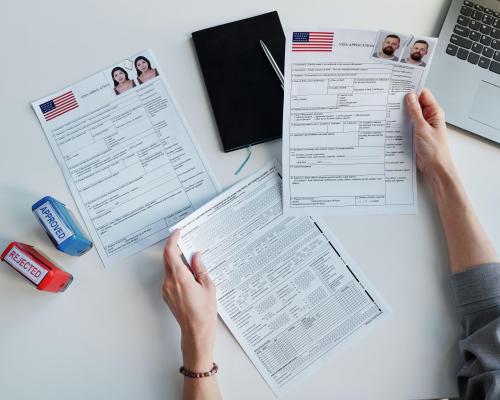
In September 2025, the U.S. Citizenship and Immigration Services (USCIS) publicly defended a new policy that allows immigration officers to consider whether applicants hold “anti-American” views when adjudicating petitions for green cards, visas, and other immigration benefits.
Joseph Edlow, Director of USCIS, told The Associated Press that the rule does not target free political speech or criticism of government. Instead, he said it aims to flag support for extremist ideologies, terrorism, or ideologies that seek to undermine U.S. institutions.
“Criticism of any administration is one of the most American activities you can engage in,” Edlow insisted, adding that the policy aims to go beyond mere dissent to focus on ideological extremism.
What the New Rule Says
Under the updated guidance, USCIS officers may weigh whether an applicant has “endorsed, promoted, supported, or otherwise espoused” “anti-American ideologies or activities.” Those ideologies could include support for terrorist or antisemitic organizations.
Importantly, the guidance also states that this scrutiny applies in discretionary cases—where the applicant has already met legal eligibility requirements but must still be approved based on a “balance of factors.”
However, the rule does not define clearly what constitutes “anti-Americanism.” Critics say that ambiguity gives officers broad leeway to interpret views subjectively.
To guard against misuse, Edlow said USCIS would not automatically deny benefits based solely on speech. He also said federal officers would not equate anti-Trump or anti-administration remarks with disqualification.
New Powers and Enforcement Tools
As part of the same policy shift, USCIS is also acquiring new authority: it may hire law enforcement agents who can execute search warrants, carry weapons, and make arrests in certain cases.
Edlow emphasized that these powers apply only to serious, large-scale fraud or criminal activity—not everyday immigration cases. He said, “They’re not a police force.”
He expects only a “couple hundred” of these agents initially. Their role is to help tackle cases that USCIS currently refers to other agencies.
USCIS is also expanding a verification program (Systemic Alien Verification for Entitlements, or SAVE) to help states and local governments confirm eligibility for public benefits and voter registration rolls.
Reactions and Criticism
Legal and Civil Liberties Concerns
Many legal experts warn that the “anti-American views” rule invites subjectivity and bias. They argue that without clear definitions, adjudicators might reject lawful immigrants based on political views or dissent.
Critics also point to constitutional limits. While noncitizens may receive fewer protections than citizens, many constitutional principles still apply to them. They argue that punishing ideology or viewpoint could run afoul of free speech norms.
Others caution that the policy may disproportionately affect immigrants from certain countries or with particular political beliefs—especially students or activists involved in protests or online activism.
Political and Social Fallout
Some observers view the rule as part of a broader immigration crackdown under the current administration, which is more aggressive in limiting legal immigration pathways.
A notable case in the controversy is the 2025 arrest of Mahmoud Khalil, a lawful permanent resident and Columbia University student involved in pro-Palestinian protests. He was detained without clear legal charge amid claims of terrorism links—raising concerns the “anti-American” policy may target political dissent.
Some see the policy as a tool to suppress activism or protest among immigrant communities and international students.
What This Means for Immigrants
- Immigrants now face scrutiny not just for criminal history or immigration violations, but for views they express—especially online.
- Social media postings, protest participation, or political opinions might be used against them even if they have legal eligibility.
- The vagueness of “anti-American” may prompt fear, self-censorship, and uncertainty among applicants.
- Legal challenges are likely, as courts weigh free speech, due process, and administrative discretion.
- USCIS will need to publish clearer guidelines to prevent inconsistent or discriminatory decisions.
Broader Implications & Comparisons
This policy reflects a broader trend of ideological vetting in immigration systems globally. Several countries already screen applicants’ social media for extremist content or disinformation.
It also extends the definition of security beyond physical threats into the realm of ideological loyalty—a shift with significant civil liberties implications.
Some analysts warn that policies like this can backfire politically. Immigrant communities and civil rights groups may mobilize, and courts may push back on excessive discretion.
Where This Policy May Face Tests
- Judicial review: Courts may be asked to determine whether the policy violates constitutional protections.
- Implementation challenges: USCIS must train officers to apply the rule fairly and consistently, avoiding bias or racial profiling.
- Public backlash: Advocacy groups may mount lawsuits or campaigns to overturn parts of the rule.
- International relations: Countries whose citizens are affected may raise diplomatic objections.
- Political shifts: Changes in administration or Congress may reverse or limit the rule.
Conclusion
The new USCIS policy marks a significant shift in U.S. immigration enforcement. For the first time, ideological views may be a factor in determining who is allowed to immigrate or naturalize. While USCIS contends it targets extremism—not dissent—the lack of precision and wide discretion worry many.
As the policy takes effect, the stakes are high: it will test how much ideological scrutiny a democratic system can tolerate without veering into suppression of dissent. Courts, immigrant communities, and civil liberties advocates will watch closely.