What’s happening
This Saturday, thousands of Americans are expected to flood streets across all 50 U.S. states in a series of “No Kings” protests. Organisers say the demonstrations are a direct response to what they view as growing authoritarian tendencies under President Trump.
The movement is coordinated by a broad coalition of civil-liberties and grassroots groups, including the American Civil Liberties Union (ACLU), MoveOn, and Indivisible. Together, they have planned more than 2,600 rallies in cities large and small, ensuring that most Americans can reach one within an hour’s drive.
The largest event will unfold on the National Mall in Washington D.C., with simultaneous gatherings in state capitals, suburban centers, and small towns.
Why the protests are happening
Organisers argue that the Trump administration has repeatedly pushed the boundaries of executive authority. They point to expanded federal force deployments, disregard for oversight, and efforts to weaken institutional checks and balances as warning signs of democratic backsliding.
The protests’ message—“No Kings”—symbolises resistance to unelected power and the rejection of any move toward autocratic rule. Demonstration leaders insist the events will be peaceful, patriotic, and grounded in the defense of constitutional rights.
Earlier “No Kings” rallies drew millions nationwide without major incidents. “We’re not protesting America,” one organiser said. “We’re protecting it.”
The GOP’s response
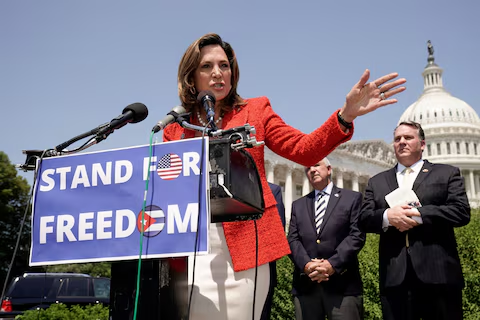
Republican leaders, however, see things very differently. House Speaker Mike Johnson and several senior GOP lawmakers have condemned the demonstrations, branding them a “Hate America” campaign.
According to Johnson, the protests will attract “pro-Hamas sympathisers,” “antifa elements,” and “Marxists in full display.” He urged citizens to “watch who shows up,” implying that the demonstrations represent radical, anti-government factions rather than concerned citizens.
Republicans have also linked the protests to the ongoing federal government shutdown, claiming Democrats are delaying a resolution to maximise turnout and media attention. Their framing portrays the event as politically motivated and disruptive rather than a legitimate expression of dissent.
Why this moment matters
This weekend’s protests come at a time of deep political division. The federal government remains partially shut down, federal workers are furloughed, and faith in public institutions continues to erode.
If turnout reaches organisers’ projections, the “No Kings” actions could become one of the largest coordinated demonstrations in modern U.S. history. The movement’s scale may reshape how Americans perceive both the Trump administration and Republican leadership.
At the same time, GOP accusations of anti-Americanism risk further deepening the partisan divide. Instead of sparking debate on executive power, the conversation could shift toward the legitimacy of protest itself.
Law-enforcement agencies are preparing extensively. In Texas, Governor Greg Abbott has ordered National Guard support ahead of the rallies. Other states have issued similar alerts, citing both security and crowd-control needs.
Tensions and risks
1. Will the protests stay peaceful?
Organisers have trained volunteers in de-escalation and crowd safety, aiming to prevent confrontation. Yet with millions potentially attending—and strong rhetoric on both sides—some tension is inevitable. Authorities remain on high alert to avoid any flashpoints.
2. Will GOP criticism influence public perception?
Republican leaders hope their “hate-America” narrative will deter turnout. However, analysts suggest the backlash may have the opposite effect by motivating more Americans to join in defense of protest rights.
3. Could the demonstrations affect the shutdown?
If protesters successfully link the shutdown to Republican obstruction, pressure could mount on Congress to compromise. Conversely, any disorder during the rallies might strengthen GOP arguments for stricter protest laws or expanded executive powers.
4. How might law enforcement handle the crowds?
Heavy police and Guard presence may reassure the public—but could also escalate tensions if perceived as intimidation. Balancing public order with the right to assemble is likely to be a defining challenge.
5. What are the long-term effects?
Should the “No Kings” movement sustain its momentum, it could reshape civic engagement in 2025 and beyond. Both major parties may need to rethink how they address voter frustration over executive overreach and democratic accountability.
Historical context
The “No Kings” protests are not spontaneous. They build on a previous “No Kings Day” held in June 2025, which saw participation in over 2,100 locations. The new October wave is broader, better organised, and positioned as a direct test of public will against perceived autocracy.
Critics note that recent years have seen an erosion of protest rights and increased use of federal power in domestic situations. Supporters counter that demonstrating peacefully is part of America’s founding tradition—and a vital reminder that government must remain accountable to the people.
Voices from both sides
Organisers’ perspective:
Ezra Levin, co-founder of Indivisible, described the rallies as “a patriotic reaffirmation of the Constitution.” He said GOP leaders are “attacking the right to protest because they fear accountability.”
Republican leaders’ stance:
Mike Johnson again called the rallies “a Hate America festival,” asserting that Democrats are “holding the country hostage” during the shutdown. “Americans will see what the radical left stands for,” he said.
Observers’ view:
Political analysts and media commentators warn that labelling peaceful dissent as extremist could set a dangerous precedent. According to The New Republic, it risks chilling free-speech rights and discouraging civic participation.
What to watch this weekend
- Turnout levels: Strong attendance will demonstrate the breadth of public opposition to authoritarian governance.
- Police and Guard response: Minimal arrests and calm management could keep focus on the protest’s message.
- Media framing: How news outlets portray the protests—as patriotic or radical—will heavily influence national sentiment.
- Congressional reaction: Lawmakers’ use of the protests in upcoming debates over the shutdown and reform bills could shift political momentum.
- After-effects: The longevity of the “No Kings” movement will determine whether it becomes a lasting civic force or a one-day statement.
Final thoughts
The “No Kings” protests are shaping up to be a defining moment in U.S. political life. For supporters, the rallies embody democratic vigilance—a warning that no leader is above the Constitution. For critics, they represent division and disruption at a time when the country needs stability.
Whatever unfolds, the movement highlights a central tension in modern American democracy: how to preserve unity while allowing dissent. As citizens march across the nation, the world will be watching not just what they oppose—but what kind of democracy they still believe in.