What Was Announced
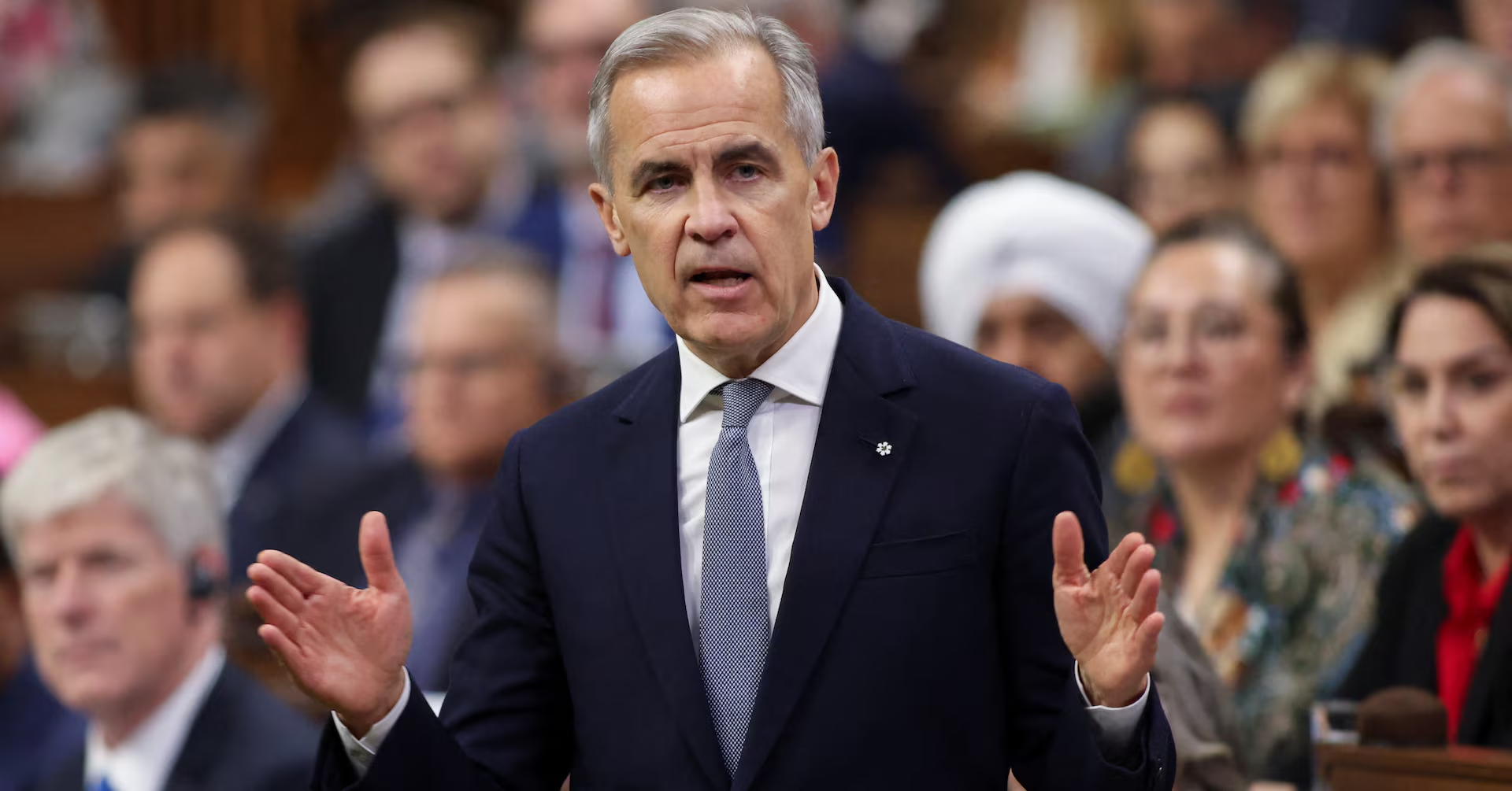
On October 22 2025, Prime Minister Mark Carney declared a bold goal: Canada aims to double its exports to countries other than the United States over the next ten years.
He tied the announcement to the upcoming federal budget (scheduled for November 4) and stressed that heavy dependence on the U.S. market — which currently accounts for roughly 75 % of Canadian exports — has become a vulnerability.
Carney said that American tariffs (especially under Donald Trump’s approach) have chilled Canadian investment and exposed Canadian jobs in industries such as autos, steel, lumber and aluminium.
He added: “We have to take care of ourselves because we can’t rely on one foreign partner.”
The government also is forecasting an additional C$300 billion in non-U.S. export value over the decade.
Why It Matters
Reducing Risk of Over-dependence
Canada’s economy has long hinged on its largest neighbour, the U.S. That once provided stability, but in the current era it introduces risk. Carney’s shift signals that Ottawa views the tight Canada-U.S. trade link as a source of potential fragility. By diversifying trade partners, Canada hopes to insulate itself from policy shocks, tariff disputes and political volatility south of the border.
Re-shaping Economic Strategy
The pivot isn’t only diplomatic—it’s economic. Doubling non-U.S. exports means identifying new markets (Asia, Europe, Latin America), realigning industries, scaling up capacity, and re-tooling supply chains. Carney called Canada an “energy super-power” with abundant oil, natural gas and critical minerals and suggested those strengths will play into the export shift.
Geopolitical and Trade Significance
In a world of rising trade protectionism and shifting alliances, Canada’s move is strategically tuned. The U.S. has lifted tariffs and engaged in trade destabilisation, and Canada feels the effects. Redirecting export flows signals to global partners that Canada is open for deeper engagement and might emerge as a more independent trade actor.
Domestic Political Impacts
The pledge reflects a response to widespread concern in Canada over U.S. trade policy, job losses in key sectors and a sense of economic vulnerability. By setting a visible target, Carney aims to connect with workers, especially in manufacturing, natural-resource and lumber regions, showing that his government intends to act, not just comment.
Key Components of the Plan
- Export Diversification: Shift more goods and services to non-U.S. markets. Carney explicitly referenced re-engagement with major economies like India and China.
- Support for Impacted Sectors: The auto, steel, lumber and aluminium sectors — heavily exposed to U.S. tariffs — will likely receive policy attention and re-orientation. Carney pointed out these sectors are “under threat”.
- Enhancing Value-added & Strategic Goods: Canada’s critical minerals, natural-resource base and energy reserves were highlighted as foundational exports for the future.
- Trade Infrastructure & Partnerships: Achieving the ambitious goal will require more trade agreements, investment in export capacity, improvements in logistics and regulatory alignment with target markets.
- Budget Alignment: The 2025/26 budget will reflect the pivot: some sectors will get investment support; others may face restructuring. According to reporting, all ministries were asked to reduce wasteful spending and refocus.
Challenges & Obstacles
Scale and Time-frame
Doubling non-U.S. exports in ten years is ambitious. Export growth at this scale requires sustained investment, capacity building and new contracts globally. Canada will need to find new markets willing to buy its goods and integrate into new supply chains — a process that takes time and resources.
Market Access & Trade Barriers
Moving beyond the U.S. means confronting new challenges: different regulatory regimes, tariff structures, certification standards and competition in Asia and Europe. Canada must negotiate or renegotiate trade deals, build relationships and overcome inertia.
Domestic Structural Constraints
Some industries in Canada are already deeply integrated with U.S. supply chains (automobiles, parts). Re-directing exports to other markets may require re-tooling, relocating production and changing business models—costly and complicated.
Also, some regions of Canada depend heavily on U.S. demand; shifting them may incur social and transitional costs.
U.S. Relationship Dynamics
While Canada wants to reduce dependence on the U.S., the relationship remains important: the U.S. still absorbs ~75 % of Canadian exports. Abrupt moves risk retaliation or loss of access. Carney’s government must balance strategic independence with pragmatic trade realities.
Global Economic Environment
Export growth depends on global demand and geopolitical stability. With rising protectionism, supply-chain disruptions, and global inflation risks, Canada’s target is vulnerable to external shocks.
What to Watch for Next
- Budget Details (Nov 4, 2025): The federal budget will reveal how the export-diversification strategy translates into spending, incentives, trade missions and sector programmes.
- New Trade Deals and Missions: Watch for Canadian efforts to deepen ties with India, China, Japan, EU countries, and ASEAN. These will be pillars of the diversification.
- Export Metrics: Over the next few years, will Canada see increased exports outside the U.S., especially in sectors identified (minerals, energy, value-added manufacturing)?
- Industry Response: How do sectors like autos, steel and lumber respond? Will investments shift and supply chains reform?
- U.S. Reaction: Will the U.S. respond to Canada’s pivot, either through trade policy or diplomatic pressure?
- Domestic Political Feedback: Will Canadian provinces and industries see the shift as positive or disruptive? Will there be pushback in regions tied closely to U.S. markets?
Broader Implications
For Global Trade
Canada’s pivot adds to a trend of middle-sized economies rethinking heavy dependence on a single major partner. Diversification reduces bilateral risk but demands more complex global engagement.
For U.S.–Canada Relations
The announcement signals a shift: Canada is signalling it cannot rely indefinitely on preferential access to the U.S. market. Over time, the Canada-U.S. trade axis may become less dominant and more balanced.
For Canadian Identity & Strategy
Carney’s language (“We can’t rely on one foreign partner,” “the decades-long process … is now over”) suggests a change in national self-perception. Canada is aiming to recast itself as a more autonomous player, regionally and globally.
For Canadian Industries
Sectors previously oriented to the U.S. will need to become more outward-looking. This may spur innovation, export readiness and competitiveness — but may also create winners and losers as transitions roll out.
Final Thoughts
Prime Minister Mark Carney’s goal to double Canada’s non-U.S. exports within a decade marks a significant strategic turn for the country. It recognises that longstanding reliance on the U.S. is no longer a strategic advantage but a potential liability.
To succeed, Canada must undertake a multifaceted effort: securing new markets, reforming domestic industries, investing in infrastructure, and managing economic risks along the way. The path will not be easy and will demand “sacrifices,” as Carney himself admitted.
The payoff, if achieved, could reposition Canada’s economy, sharpen its global engagement, and give Canadian workers and firms greater resilience in volatile trade times.
For Ottawa, the next few years will test whether this is merely aspirational rhetoric or the start of a lasting strategic realignment.