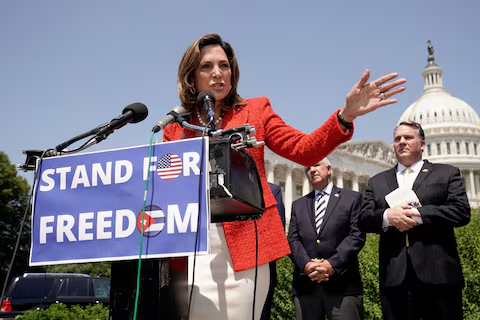
In today’s United States, the political slogan America First has resurfaced with force. It reflects a shift from global engagement toward a nationalist, inward-looking emphasis. As that emphasis becomes central in politics, the media we consume—its scope, tone and structure—must adapt accordingly. If the guiding motto of the nation is “America First,” then the news we read cannot remain the old global-first, objective-detached journalism. Instead, it must reflect new priorities: domestic focus, scrutiny of national institutions, and recalibrated lenses.
1. What “America First” Means in Practice
Historically, “America First” emerged in various forms—most famously in the 1940s isolationist movement. Today, it signals a re-ordering of priorities: trade deals come under the banner of protecting domestic workers; alliances are weighed in terms of national interest; immigration is framed as a domestic economic and cultural issue. According to one analyst, the era of liberal internationalism may be giving way to a “return to the natural position of the United States” as an offshore balancer, not always the world’s policeman.
In other words, if the political identity of the country emphasizes “America First,” then the frameworks of public debate must catch up—or risk irrelevance.
2. Why the News Must Adjust
When the political priority shifts, the media’s role changes too. Let’s consider three reasons why the news we consume must adapt:
a) Focus matters
Traditional news coverage often prioritised international stories and global contexts, under the assumption that American leadership and engagement were essential. But if domestic priorities steer policy, then the public needs deeper coverage of national institutions: how power is exercised internally, how rights are defended or challenged, and how domestic inequalities evolve. A “global-first” newsroom will miss key national issues.
b) Framing changes
If “America First” guides governance, then stories about trade, immigration or defence must be viewed through a national interest lens. Journalists must ask: Does this policy protect American workers? Does this alliance advance U.S. strategic autonomy? Does the immigration flow serve the national labour market and civic cohesion? Without these questions, news risks being disconnected from political reality.
c) New accountability
Media often serve as watchdogs of power. Under “America First,” the appropriate institutions to scrutinise may shift—from foreign aid budgets to domestic relief programmes; from international treaties to national‐infrastructure policy; from global climate commitments to U.S. resilience. The media must reposition its investigative focus accordingly.
3. How Newsrooms Can Evolve
For the news-ecosystem to align with an “America First” politics, several key changes are worth considering:
i. Domestic policy beats elevated
News organisations should strengthen coverage of sectors previously under-covered: labour markets, infrastructure, industrial policy, regional economic disparities, domestic supply chains, and civic institutions. For instance, a story about a factory closure in a rust-belt state should get as much weight as a diplomatic row abroad (if national identity centres on jobs and communities).
ii. Trade and economy reframed
When the country emphasises national interest, trade stories should incorporate analysis of who wins and who loses within the country. For example: what does a free-trade agreement mean for specific American industries, communities, wages and regional fairness? A simple tally of aggregate GDP gains falls short.
iii. Immigration and demography in national context
“America First” rhetoric often places immigration in terms of national absorption and economic impact. Journalists should examine how immigration flows affect domestic labour markets, housing, local governance, and societal cohesion—not only in global or humanitarian terms.
iv. Rethinking foreign coverage
International events and conflicts still matter, but coverage may need adjusting: not merely “what happened” but “what does this mean for U.S. interests, sovereignty and national strategy?” For example, a security alliance becomes significant if it directly supports American autonomy and benefit—not only collective global benefit.
v. Civic institutions and community accountability
If nationalism emphasises the nation, then reporting on the health of U.S. domestic institutions (courts, regulatory agencies, public media, the civil service) becomes critical. Investigative journalism should treat domestic systems with the same intensity previously reserved for foreign governments.
4. Risks if News Doesn’t Adapt
If journalism fails to evolve along with shifting political priorities, several risks emerge:
- Irrelevance: The public may feel news is detached from their concerns—jobs, local infrastructure, community stability—and turn elsewhere (social media, partisan news).
- Loss of legitimacy: If media continue to focus globally while local issues fester, readers may distrust elite news outlets, leading to fragmented information and echo-chambers.
- Vulnerability to propaganda: In a nationalist era, narratives that emphasise “us vs them” can flourish. Without strong domestic accountability coverage, the news may inadvertently amplify populist strains rather than challenge them.
- Weak oversight: If media neglect domestic policy and focus abroad, powerful national actors might face less scrutiny, leading to erosion of institutional checks and civic resilience.
5. Example Case: The Economy Under “America First”
Take labour markets. Under “America First,” job-creation and domestic manufacturing become political priorities. A newsroom aligned with this would:
- Report on disruptions in regional manufacturing, not just national unemployment figures.
- Investigate supply-chain shifts (automotive, battery production), asking which American regions benefit and which lag.
- Follow the policy pipeline: human-capital investment, training programmes, regional tax incentives, infrastructure spending.
By contrast, if journalism remains focused on global trade statistics and geopolitical maneuvering alone, it may overlook the lived experience of working-class Americans and the policy levers meant to support them.
6. Global Interdependence Versus National Priorities
Some critics will argue that “America First” politics are isolationist and that news therefore should maintain global outlooks. They are right to a degree—the world remains interconnected. However, the shift is not necessarily about ignoring the world, but re-ordering priorities. The journalism challenge is to balance national interest with global awareness.
For example:
- How does a regional energy investment abroad affect American jobs?
- How does a foreign-aid cut influence U.S. strategic positioning and cost?
- How does a global carbon deal affect American industries, skill-sets and regional development?
Such framing keeps the international dimension but ties it back to national impact.
7. The Way Forward for News Consumers
Readers and viewers can also adapt:
- Demand news that ties global events back to national implications: “Why should Americans care?”
- Look for coverage of localities, policy implementation, community outcomes—not just big central headlines.
- Support outlets that invest in investigative domestic reporting, regional beats, civic oversight.
- Be mindful of sources: ask whether a story about foreign policy also explores the American dimension—jobs, budget, democracy.
8. In Summary
When a nation’s politics declare “America First,” it sends an implicit message about priorities: the country, its citizens, its institutions come ahead of all else. In response, the news we read should prioritise coverage accordingly—focus on domestic concerns, tie global events to national interest, reclaim oversight of home institutions, and ground dialogue in lived realities of Americans rather than distant abstractions.
If journalism resists this shift, it risks irrelevance, distrust and fragmentation. On the other hand, if it adapts thoughtfully, it can remain essential—helping citizens understand not only what is happening in the world, but how it affects their nation, their communities, their future.
In a time when politics says “America First”, the news must say: “We cover America. First and front.”