Warren Buffett’s Retirement
Berkshire loses its best pitchman as Warren Buffett prepares to step down as chief executive at the end of 2025, closing a defining chapter in American corporate history. Buffett became the world’s most famous investor through decades of disciplined capital allocation at Berkshire Hathaway, yet his influence extended far beyond balance sheets. He also served as the company’s most recognizable ambassador, marketer, and cultural symbol.
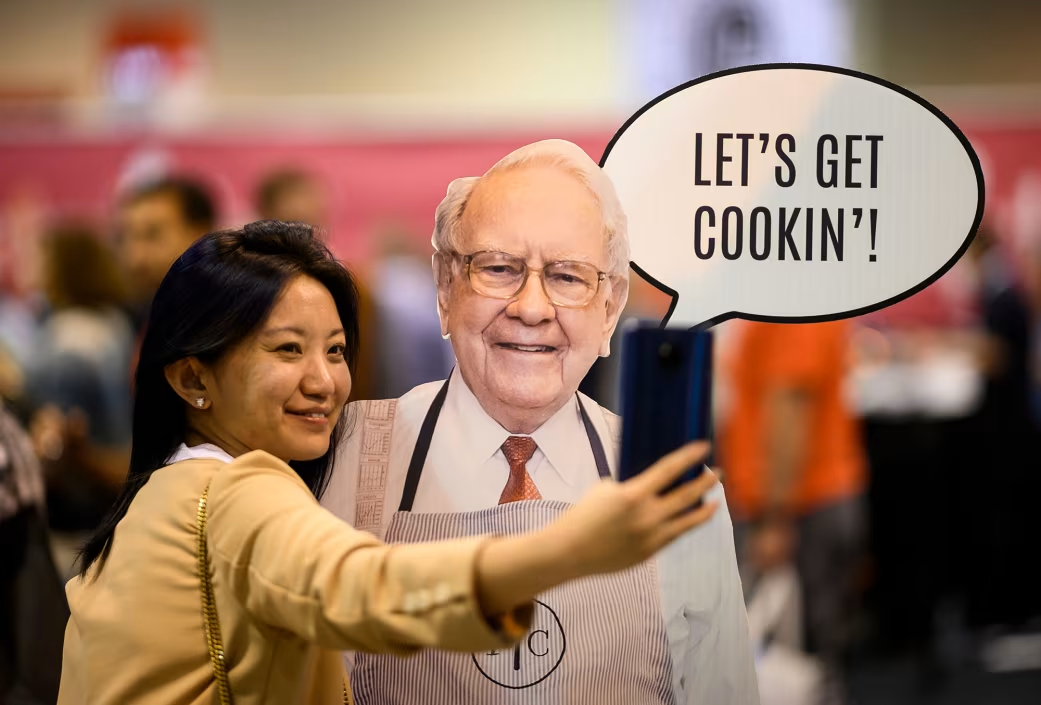
Each year, tens of thousands of shareholders flocked to Omaha not just for financial insights, but for an experience carefully shaped by Buffett’s personality. The annual meeting evolved into a hybrid of investor conference and consumer showcase, where Berkshire’s sprawling portfolio came to life. As a result, Berkshire loses its best pitchman not simply in leadership terms, but in the loss of a unifying figure who humanized a vast corporate empire.
Buffett’s ability to blend credibility, humor, and accessibility transformed Berkshire into more than a holding company. Consequently, his retirement raises questions about how the conglomerate will maintain its distinctive identity without its most effective storyteller.
The annual meeting as Buffett’s marketing masterpiece
For decades, the Berkshire Hathaway annual meeting functioned as Buffett’s stage. While investors arrived seeking guidance, they stayed for the spectacle. The “Berkshire Bazaar of Bargains” became synonymous with the event, showcasing products from across the conglomerate’s holdings. In 2025 alone, the company said the bazaar would span 20,000 square feet and feature roughly 50,000 items of inventory.
Buffett embraced this role enthusiastically. He posed with mascots, joked with shareholders, and turned ordinary consumer goods into memorabilia. His presence transformed brands into experiences, reinforcing loyalty among investors and customers alike. Therefore, Berkshire loses its best pitchman because no successor is likely to replicate this blend of authenticity and promotional instinct.
Squishmallows and the rise of Buffett as mascot
Among the most striking examples of Buffett’s cultural reach was the rise of Squishmallows at the annual meeting. The plush toys entered Berkshire’s orbit after the company acquired Alleghany in 2022, the parent of Squishmallow-maker Jazwares.
In 2023, Squishmallows resembling Warren Buffett and his longtime partner Charlie Munger debuted in Omaha. They sold out almost immediately, later fetching hundreds of dollars online. This phenomenon highlighted how Buffett himself had become part of the product ecosystem. In that sense, Berkshire loses its best pitchman because he was also one of its most successful brands.
See’s Candies and personal conviction
Buffett’s promotional power often stemmed from genuine enthusiasm. See’s Candies, acquired by Berkshire in 1972, exemplified this approach. Buffett frequently cited the company as a model investment, praising its brand loyalty and pricing power.
At shareholder meetings, See’s products featured prominently, often alongside playful Buffett-themed packaging. This personal endorsement carried weight, reinforcing trust among investors. Consequently, Berkshire loses its best pitchman because his credibility amplified the value of even the most traditional brands.
Read Also
Outgoing Walmart CEO profile
Trump and Marjorie Taylor Greene political tensions
Inside the Trump–Marjorie Greene feud
Heinz, Kraft, and the power of familiarity
Buffett’s long association with Kraft Heinz further illustrated his role as brand champion. After Berkshire and 3G Capital acquired Heinz in 2013, Buffett became a visible advocate for the company’s products. Even after the eventual split of Kraft and Heinz, Berkshire remained the company’s largest shareholder.
Commemorative items bearing Buffett and Munger’s likeness appeared across ketchup bottles and macaroni packaging, reinforcing the personal connection. Although Buffett later expressed disappointment with the company’s performance, his presence continued to anchor investor confidence. Thus, Berkshire loses its best pitchman not only in promotion, but in reassurance during challenging periods.
From Fruit of the Loom to Brooks Running
Buffett’s influence extended into apparel and athletics. After Berkshire acquired Fruit of the Loom in 2001, Buffett-themed boxers became a staple of shareholder shopping days. The humor reinforced loyalty while underscoring Berkshire’s diverse reach.
Similarly, Berkshire-backed Brooks Running embraced Buffett’s image, even placing caricatures of him and Munger on limited-edition running shoes. These gestures blurred the line between corporate ownership and personal endorsement, a dynamic difficult to replicate.
Coca-Cola, Duracell, and lasting symbolism
Berkshire’s status as the largest shareholder of Coca-Cola led to international promotional items, including cans bearing Buffett’s likeness for overseas markets. Meanwhile, the acquisition of Duracell enabled one of the most symbolic tributes: a portrait of Buffett constructed entirely from batteries.
These images captured how deeply Buffett’s identity intertwined with Berkshire’s brands. As he steps aside, Berkshire loses its best pitchman because his personal symbolism cannot be transferred through succession planning alone.
Life after Buffett as the face of Berkshire
With Buffett’s retirement approaching, Berkshire faces a transition unlike any in its history. Operational leadership may continue smoothly, yet the cultural shift will be profound. No future executive is likely to serve simultaneously as investor, mascot, and moral authority.
Berkshire loses its best pitchman at a moment when corporate storytelling matters more than ever. The challenge ahead lies in preserving trust, identity, and shareholder engagement without the singular figure who embodied all three.