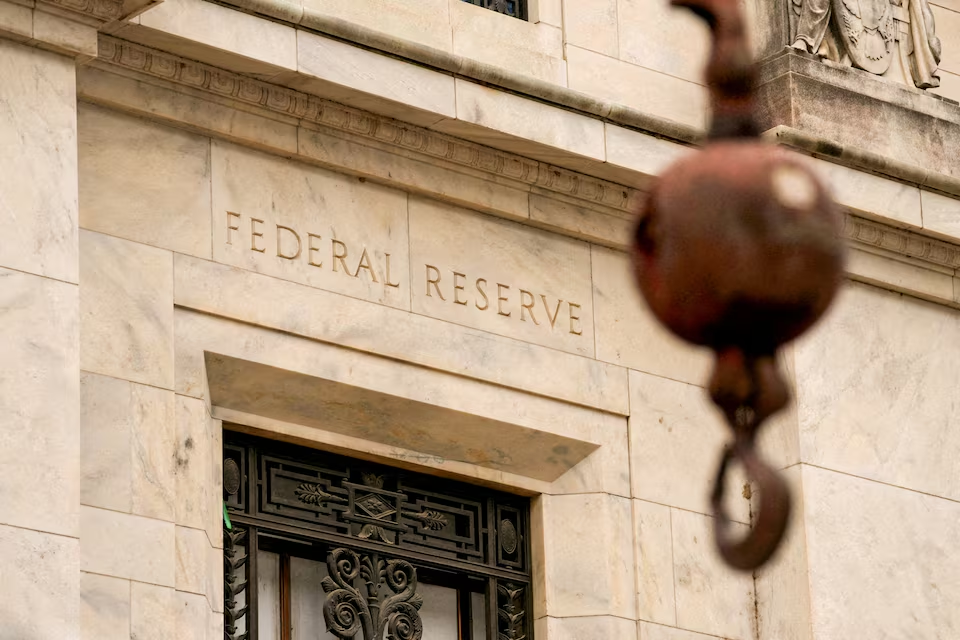
The Federal Reserve is expected to keep its benchmark interest rate unchanged through the end of Chair Jerome Powell’s term in May 2026, according to a Reuters poll of economists released on February 11, 2026. Respondents anticipate the first rate cut to occur in June, reflecting caution amid persistent inflation and solid growth.
This Fed rate decision outlook emerges as the central bank navigates a complex economic landscape. Powell has maintained a data-dependent approach, resisting pressure for aggressive easing. The poll, conducted between February 5 and 10 among over 100 economists mostly from banks and financial firms, shows stronger consensus than previous surveys.
Three-quarters of forecasters, 75 out of 101, predict the Fed will hold rates steady at the March meeting. This marks an increase from 58% in the prior poll. By the end of the second quarter, nearly 60% expect the federal funds rate to settle in the 3.25-3.50% range, with June as the most likely timing for the initial reduction.
Economic projections support this cautious stance. Growth in the final quarter of 2025 slowed to an estimated 2.9% annualized rate, down from 4.4% in the third quarter. Forecasts for 2026 show expansion between 2% and 2.4%, above the Fed’s non-inflationary potential of 1.8%. The full-year median for 2026 rose to 2.5%, marking the third consecutive upward revision in Reuters polls.
Inflation remains elevated. Expectations place average readings well above the 2% target throughout the year. Unemployment is projected to hold steady near 4.5%, suggesting limited need for immediate stimulus.
Concerns Rise Over Fed Independence and Warsh Nomination
A significant portion of economists expressed unease about the future of Fed independence once Powell departs. Over 70% voiced concerns about potential erosion after May 2026. This stems largely from President Donald Trump’s repeated criticisms of Powell and his nomination of Kevin Warsh to succeed him.
Warsh, a former Fed governor, has drawn scrutiny for shifting signals on policy. Earlier positions leaned hawkish, favoring restraint, while recent comments highlight optimism about AI-driven productivity gains as disinflationary forces. Many respondents noted this apparent pivot raises questions about future direction.
The Fed rate decision under Warsh prompts particular worry. Of those answering a follow-up question, 49 out of 53 said policy risks becoming too loose rather than too tight. Economists cited potential over-easing despite robust growth and sticky inflation.
Stephen Juneau, U.S. economist at Bank of America, noted that additional cuts under Warsh may not align with clear economic justification. He warned that combining rate reductions with expansionary fiscal policy could lead to overheating.
Oscar Munoz, chief U.S. macro strategist at TD Securities, observed that Warsh appeared more inclined toward easing during Republican administrations. He emphasized that policy should remain independent of political leadership.
James Knightley, chief international economist at ING, pointed out that Warsh holds only one vote on the Federal Open Market Committee. Convincing other officials to support aggressive cuts would prove challenging, even for a new chair.
Market Expectations and Policy Path Ahead
A majority of forecasters still anticipate at least two rate cuts in 2026, consistent with January views. No firm consensus exists on the year-end rate level, reflecting uncertainty around incoming leadership.
The poll highlights broader confusion surrounding Warsh’s stance. Respondents indicated they await his nomination hearings for clearer signals on commitment to the 2% inflation target and institutional independence.
Current economic indicators argue against rapid easing. Steady labor markets, above-trend growth, and persistent price pressures support a patient approach through spring 2026.
Implications for Businesses and Investors
A steady Fed rate decision through May provides short-term predictability for borrowing costs. Businesses planning investments benefit from stable financing conditions in the near term.
Anticipated June cuts could ease pressure on debt servicing later in the year. However, fears of overly accommodative policy under new leadership introduce risks of renewed inflationary pressures or asset bubbles.
Investors monitor upcoming data releases closely. Strong employment figures or sticky core inflation could delay the expected pivot, while softer readings might accelerate easing expectations.
The transition period carries added uncertainty. Markets will parse statements from Powell in coming months and prepare for Warsh’s confirmation process.
Economists stress the importance of maintaining credibility. Any perception of political influence on the Fed rate decision could undermine confidence in the institution’s ability to deliver price stability.
As 2026 unfolds, the Federal Reserve faces the challenge of balancing growth support with inflation control. The Reuters poll underscores a cautious near-term path, tempered by longer-term concerns about policy direction and independence. Outcomes will depend on incoming data, leadership dynamics, and the Fed’s resolve to prioritize its dual mandate.