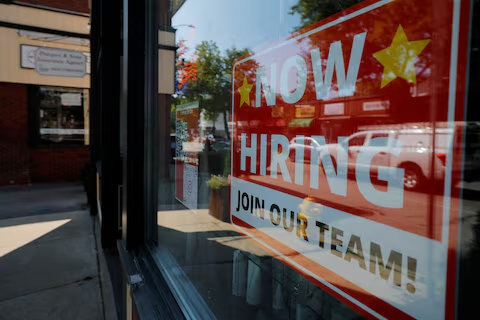
The number of Americans filing new applications for jobless benefits increased slightly last week and the unemployment rate appeared to hold steady in February amid a stable labor market. The weekly jobless claims report from the Labor Department on Thursday suggested the labor market remained in a low hire, low fire state. The US jobless claims increase of 4,000 brought the seasonally adjusted total to 212,000 for the week ended February 21.
Economists polled by Reuters had forecast 215,000 claims for the latest week, so the actual figure came in slightly below expectations. Last week’s claims included the Presidents’ Day holiday, which could have impacted the data. Still, claims were below the levels seen during the same period last year. The modest US jobless claims increase does not signal deterioration.
Economic Context
The labor market is regaining its footing after hitting a soft patch last year amid uncertainty economists attributed to President Donald Trump’s broad tariffs. The US jobless claims increase occurs within this broader stabilization trend. The Supreme Court last Friday struck down the tariffs, which Trump pursued under a law meant for use in national emergencies.
Trump swiftly imposed a 10 percent global tariff for 150 days to replace some of the emergency duties, before raising the rate to 15 percent over the weekend. Economists said the latest moves created near-term uncertainty but anticipated minimal economic impact. The US jobless claims increase reflects ongoing adjustment rather than crisis.
Carl Weinberg, chief economist at High Frequency Economics, offered optimistic assessment. “The data show no sign of the layoffs we would expect in a weakening labor market during the early days of a hypothetical recession,” he said. “That will jolly up traders who believe the Fed will not cut rates anytime soon, given a steady labor market and inflation above target.”
Continuing Claims Decline
The number of people receiving unemployment benefits after an initial week of aid, a proxy for hiring, dropped 31,000 to a seasonally adjusted 1.833 million during the week ended February 14. The so-called continuing claims covered the period during which the government surveyed households for February’s unemployment rate. The US jobless claims increase in initial filings contrasts with decline in continuing claims.
Continued claims rose modestly between the January and February survey weeks. The jobless rate eased to 4.3 percent in January from 4.4 percent in December. The Chicago Fed forecast the unemployment rate steady at 4.28 percent in February, which would round up to 4.3 percent. This stability supports view of steady labor market.
Hiring Concerns Remain
Nancy Vanden Houten, lead US economist at Oxford Economics, highlighted ongoing concerns. “The low hiring rate is still the most concerning aspect of the labor market, but the trend in continued claims suggests employers aren’t pulling back further,” she said. The US jobless claims increase does not capture hiring dynamics directly.
Lingering uncertainty from the since-invalidated import duties was blamed for a general hesitancy among businesses to increase hiring. A rapid adoption of artificial intelligence is adding another layer of caution, economists said. These structural factors affect labor market beyond cyclical conditions.
The combination of low hiring and low layoffs produces stable unemployment but limited opportunity. Workers seeking to change jobs or enter workforce face constrained options. The US jobless claims increase reflects only one dimension of labor market experience.
Consumer Anxiety
While the labor market is stabilizing, consumers remain anxious about their employment prospects. A survey from the Conference Board this week showed the share of consumers who viewed jobs as hard to get increased to a five-year high in February. However, households also believed the availability of jobs had improved. The US jobless claims increase may not capture this anxiety.
The median duration of unemployment is near four-year highs, indicating that those out of work face extended searches. Jobs remain scarce for young college graduates, labor market data shows. Unemployed recent college graduates do not show in the claims data because they have limited or no work history, making them ineligible to file for jobless benefits. The US jobless claims increase thus understates youth employment challenges.
Benefit Exhaustion Factor
Continuing claims could be falling because some people have exhausted their eligibility, limited to 26 weeks in most states. This technical factor complicates interpretation of declining continuing claims. The relationship between claims and broader unemployment is not straightforward.
Oliver Allen, senior US economist at Pantheon Macroeconomics, explained the limitations. “The relationship between continuing claims and unemployment is far from airtight, given that the long-term unemployed, new entrants to the labor market, and those re-entering from inactivity, all are ineligible to claim,” he said. The US jobless claims increase only captures subset of labor market distress.
Allen added that the Conference Board survey’s hard to get jobs measure was a very reliable indicator in the past. He said it points to the unemployment rate rising again soon. This warning contrasts with current stability.
Fed Policy Implications
The stable labor market supports economists’ expectations that the Federal Reserve would not cut interest rates before Fed Chair Jerome Powell’s term ends in May. With inflation above target and employment steady, the case for rate reduction weakens. The US jobless claims increase does not alter this calculus.
Financial markets have adjusted expectations accordingly. Traders now anticipate later timing for any rate cuts. The steady labor market provides Fed with flexibility to maintain current stance.
Weinberg noted that traders who believe the Fed will not cut rates anytime soon will be jollied up by the data. The combination of steady labor market and inflation above target supports patient approach. The US jobless claims increase fits this narrative.
Tariff Uncertainty
The Supreme Court’s rejection of Trump’s emergency tariff approach created legal uncertainty. The administration’s rapid response with new global tariff framework attempts to maintain policy direction. However, the legal basis differs and may face separate challenges.
Economists downplay immediate economic impact of these maneuvers. The modest US jobless claims increase suggests no dramatic effect on employment. However, sustained uncertainty could affect business investment and hiring over time.
The artificial intelligence factor adds longer-term structural dimension. Companies may hesitate to hire if they anticipate automation replacing roles. This caution affects labor market regardless of tariff policy.
Regional and Demographic Variations
National averages mask significant variation across regions and demographic groups. Some areas experience stronger labor markets while others lag. Young workers, less educated workers and minority groups often face higher unemployment than national average suggests.
The US jobless claims increase may concentrate in certain sectors or locations. Manufacturing, retail and hospitality show different patterns than professional services. Aggregate data smooths these differences.
Policy responses must account for this variation. National interest rate decisions affect all regions similarly but local conditions differ. The Fed’s tools are blunt instruments for addressing heterogeneous labor markets.
The labor market appears stable for now with low layoffs and low hiring. The US jobless claims increase remains modest and within normal range. Continuing claims decline suggests those who lose jobs find them reasonably quickly.
However, underlying concerns persist about hiring rates and long-term unemployment. Young workers face particular challenges entering workforce. The combination of tariff uncertainty and AI adoption creates caution among employers.
The Federal Reserve watches these developments closely. Any significant deterioration could shift rate cut timing. For now, the US jobless claims increase signals stability rather than weakness. The labor market continues its gradual normalization after last year’s soft patch.