Australia is reeling from the Bondi Beach attack. In fact, the violent assault has sparked national grief and urgent calls to confront rising antisemitism. Former Prime Minister Tony Abbott called it a “day of shame for my country.” Moreover, he stressed it was the worst atrocity against Jews anywhere in the world since October 7. The attack occurred during Hanukkah near Sydney’s famous shoreline. Suddenly, two gunmen opened fire—killing several people and injuring many others.
Police quickly identified the shooters as brothers Sajid and Naveed Akram. Before the attack, they had lived in Bonnyrigg, a western Sydney suburb. However, just days earlier, they moved to an Airbnb in Campsie. As a result, they positioned themselves closer to the crowded beach during a holiday weekend.
Tony Abbott strongly criticized what he sees as growing tolerance for anti-Jewish hate speech. Speaking on BBC Radio 4, he said, “I am appalled as an Australian.” He added that such an atrocity happened right here on Australian soil. Furthermore, he pushed back against Prime Minister Anthony Albanese’s immediate call for stricter gun laws. “He’s throwing up a smoke screen,” Abbott argued. “Sure, we might need better gun laws—but what we need most is zero tolerance for anti-Jewish hate speech.”
In particular, Abbott highlighted double standards in how authorities handle public protests. For instance, he noted that no one would allow a crowd in London to chant for British soldiers’ deaths. Yet in Sydney, demonstrators have marched across the Harbour Bridge shouting “Death to the IDF.” Authorities did not stop them. Therefore, Abbott insists this must change immediately.
In the emotional aftermath, members of Sydney’s Jewish community gathered at the Bondi Pavilion. They held a spontaneous menorah lighting ceremony to honor the victims. Rabbi Yossi Shuchat led the gathering. He explained that he and his friends felt a deep need to come. “We wanted to remember the victims the way they would have wanted,” he said. “By adding light, goodness, and kindness.”
Additionally, Rabbi Shuchat called for stronger protections for religious minorities. He emphasized that all Australians should feel safe practicing their faith. “We are all shocked,” he added. “We pray leaders will act swiftly to bring justice and safeguard our freedoms.”
Meanwhile, an ordinary citizen became a hero during the chaos. Ahmed Al Ahmed, a 43-year-old fruit shop owner, ran toward one of the gunmen. Without hesitation, he wrestled the weapon from the attacker’s hands. Video footage shows him turning the gun on the shooter and forcing him to retreat. Consequently, many believe his bravery saved lives.
A GoFundMe campaign for Al Ahmed has since raised nearly $1 million. Notably, billionaire investor William Ackman donated $99,999—the platform’s maximum amount. He praised Al Ahmed as a “brave hero” in a social media post.
Law enforcement responded rapidly after the attack. Officers raided the Akram brothers’ former home in Bonnyrigg. They arrested three people linked to the residence. However, all three were later released without charges. Investigators are now tracing the attackers’ movements, digital activity, and possible ideological ties. Clearly, the move to Campsie was strategic—it placed them near the beach at a peak time.
Ultimately, the Bondi Beach attack has forced Australia to confront hard truths. Many agree that hate speech—especially antisemitism—has gone unchallenged for too long. While gun control matters, leaders across the spectrum stress that words can incite violence. As Abbott warned, silence enables hate to grow.
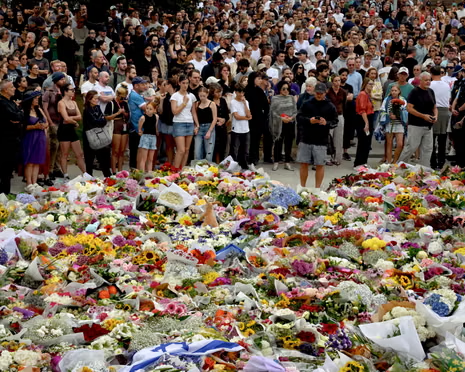
As flowers pile up at makeshift memorials and donations pour in, Australians demand more than condolences. Instead, they call for concrete action to protect their pluralistic society. Above all, the Bondi Beach attack must become a turning point—not just another tragedy.
READ: Brown University Shooting Suspect Released as Evidence Shifts