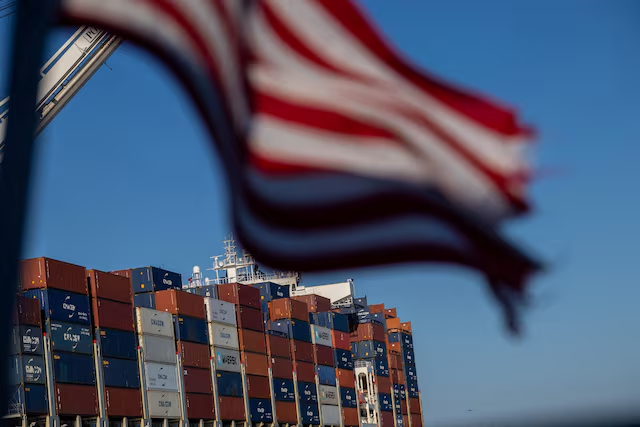
President Donald Trump’s return to the White House in 2025 marked a major shift in global trade. His administration’s aggressive tariff policies increased import taxes to the highest levels seen since the Great Depression. These measures, aimed at reviving the U.S. manufacturing base, caused significant market disruption. Moreover, they prompted rounds of negotiations for new trade and investment deals, with countries seeking ways to lower tariffs.
Trump’s tariffs raised the average tariff rate to nearly 17%, a huge increase from less than 3% at the end of 2024. According to Yale Budget Lab, the tariffs now generate about $30 billion in monthly revenue for the U.S. Treasury.
Global Reactions and Deals Struck
The tariff changes caused global leaders to scramble for agreements. Many sought deals to reduce the imposed tariffs, often offering billions in U.S. investments. Framework agreements were signed with key trading partners, including the European Union (EU), the United Kingdom, Japan, South Korea, and Vietnam. However, a final agreement with China has remained elusive, despite multiple rounds of talks and even a face-to-face meeting between Trump and Chinese President Xi Jinping.
The EU’s agreement, which included a 15% tariff on exports, drew criticism. French Prime Minister François Bayrou called it an “act of submission” and a “sombre day” for the bloc. However, some saw it as the “least bad” option available. Despite the tariff, European exporters adapted and found new markets. According to French bank Societe Generale, the direct impact of the tariffs on the EU’s GDP was just 0.37%.
China’s Economic Resilience and U.S. Tariff Impact
Despite Trump’s tariffs, China’s trade surplus defied expectations, surpassing $1 trillion. China shifted away from the U.S., upgrading its manufacturing sector and expanding its global influence. Additionally, China’s dominance in rare earth minerals gave it leverage over the U.S. and Europe, allowing it to push back against pressure to reduce its trade surplus.
Contrary to predictions of an economic collapse, the U.S. economy did not suffer the high inflation many economists had feared. The economy contracted modestly in the first quarter of 2025, largely due to a rush to import goods before tariffs took effect. However, the economy quickly rebounded, driven by a boom in artificial intelligence investments and resilient consumer spending. The International Monetary Fund raised its global growth forecast twice in the months following Trump’s tariff announcement, as uncertainty eased and trade deals helped mitigate the effects of tariffs.
2026 Outlook: Legal and Political Challenges
Looking ahead to 2026, a big question is whether Trump’s tariffs will stand. A legal challenge to his “reciprocal” tariffs is set to be decided by the U.S. Supreme Court in early 2026. If the court rules against Trump, the administration may turn to other legal mechanisms to maintain tariffs, but these would likely be more cumbersome and limited in scope. A loss in the court could lead to renegotiations of current deals or create more uncertainty in global trade.
Europe and China’s Trade Relations in 2026
For Europe, the focus will shift to its relationship with China. China has increasingly depreciated its currency and upgraded its manufacturing capabilities, benefiting its exporters. On the other hand, European companies have struggled to penetrate the slowing Chinese market. In 2026, Europe may need to take stronger action to address trade imbalances with China, possibly through tariffs or other measures.
U.S.-China Trade Negotiations
The U.S.-China trade relationship remains central to global trade dynamics. The shaky detente reached in 2025 will expire in the second half of 2026. Both Trump and Xi are expected to meet twice during the year to discuss trade. These meetings will be pivotal in shaping the future of U.S.-China relations.
U.S.-Canada-Mexico Free Trade Agreement Review
Lastly, the U.S.-Mexico-Canada Agreement (USMCA) is up for review in 2026. The future of the deal remains uncertain, with Trump possibly opting to let it expire or retool it to better align with his objectives.
Expert Insights for 2026
According to Chris Iggo, chief investment officer at AXA Investment Managers, the Trump administration might ease its harshest tariff policies to mitigate inflation concerns. “A reduction in tariffs or at least no further increases would be helpful for the inflation outlook,” Iggo said. He added that a trade deal with China would improve the U.S. outlook politically and economically, especially as midterm elections approach.